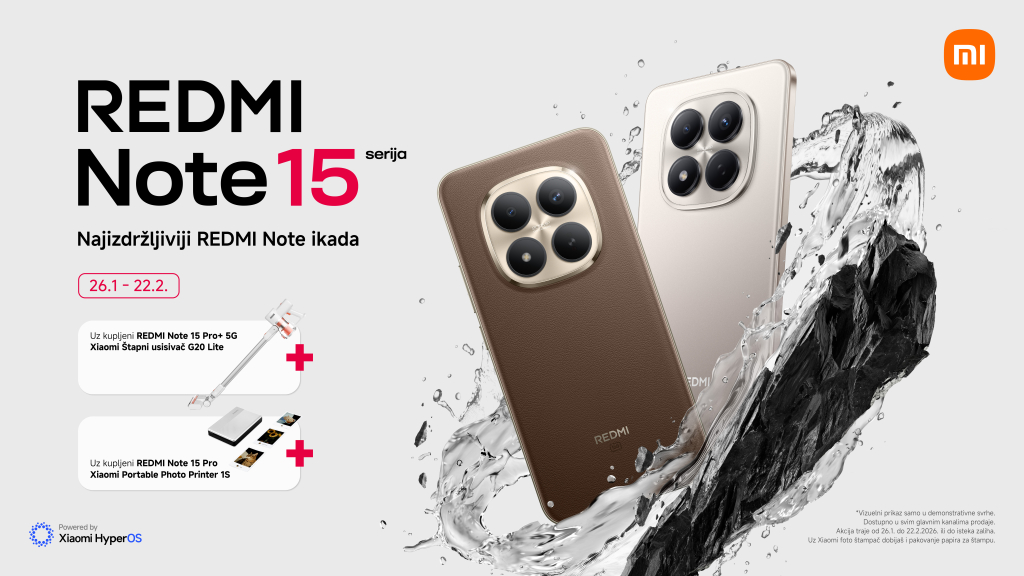
The Redmi Note 15 Pro+ 5G represents Xiaomi’s 2026 flagship vision for the mid-range segment, shifting focus from raw processing power toward extreme durability and “ultra-marathon” battery life.
Below is an expert technical breakdown and analysis of the device.
Technical Specifications
1. Display and Build
-
Panel: 6.83-inch CrystalRes AMOLED, 12-bit color depth (68 billion colors).
-
Resolution: 1.5K ($2772 \times 1280$ pixels), ~447 ppi.
-
Refresh Rate: 120Hz Adaptive with 2560Hz instantaneous touch sampling.
-
Brightness: 3200 nits peak; 1800 nits HBM (High Brightness Mode).
-
Durability: Titan Durability architecture featuring Corning Gorilla Glass Victus 2 and a reinforced aluminum-alloy frame.
-
Ingress Protection: Extraordinary IP66/IP68/IP69/IP69K ratings (resistant to high-pressure steam jets and submersion).
2. Performance and Storage
-
Chipset: Qualcomm Snapdragon 7s Gen 4 (4nm process).
-
CPU/GPU: Octa-core (up to 2.7GHz) paired with the Adreno 810 GPU.
-
Memory: 8GB or 12GB LPDDR4X RAM.
-
Storage: 256GB or 512GB UFS 2.2 internal storage (no microSD slot).
-
OS: Xiaomi HyperOS 2.0 based on Android 15.
3. Optics (Camera System)
-
Main: 200MP Samsung HPE sensor ($1/1.4″$), f/1.7 aperture, OIS. Supports 2x and 4x “optical-grade” lossless sensor crop.
-
Ultra-Wide: 8MP, f/2.2.
-
Selfie: 32MP front-facing camera.
-
Video: Supports 4K at 30fps and 1080p up to 120fps (Gyro-EIS).
4. Battery and Charging
-
Capacity: 6500mAh Silicon-Carbon (Si/C) battery.
-
Charging: 100W HyperCharge (100% in approx. 40 minutes).
-
Features: 22.5W reverse wired charging; rated for 1600 cycles (approx. 6 years of health).
Expert Analysis & Description
Design Philosophy: “The Rugged Professional”
Xiaomi has pivoted the Note 15 Pro+ away from the “slim-at-all-costs” trend. While it remains aesthetically pleasing with its quad-curved glass and optional vegan leather (Mocha Brown), the engineering priority is survivability. The inclusion of the IP69K rating—usually reserved for specialized rugged phones—means it can survive high-temperature water jets, making it one of the most durable mainstream smartphones on the market.
Performance: Efficiency over Benchmarks
The Snapdragon 7s Gen 4 is a “comfort” SoC. It doesn’t aim to beat the Snapdragon 8 series in gaming, but it provides a stutter-free experience in HyperOS 2.0. The use of UFS 2.2 storage is a slight bottleneck for a “Pro+” model in 2026, where UFS 3.1 or 4.0 would have been preferred for faster app installs and data transfers.
Imaging: The 200MP Utility
The 200MP sensor remains the star. Its strength lies in daylight detail and computational zoom. While it lacks a dedicated telephoto lens, the high-resolution crop provides surprisingly clean 4x shots. However, the secondary 8MP ultra-wide remains the “weakest link,” feeling more like a legacy component than a pro-grade tool.
Professional Opinion
The Verdict: 8.9/10
The Redmi Note 15 Pro+ 5G is no longer trying to be a “flagship killer” in speed; instead, it is a “utility killer.” > Strengths: > * The 6500mAh battery combined with 100W charging is arguably the best power configuration in its price bracket.
The IP69K rating offers peace of mind that is virtually unmatched in the mid-range.
The 1.5K display is flagship-quality in terms of brightness and eye protection (3840Hz PWM dimming).
Weaknesses:
Performance Ceiling: Not ideal for heavy “Genshin Impact” style gaming compared to Poco or Pixel rivals.
Software: HyperOS still contains significant bloatware, though HyperAI features (Writing/Search) add genuine value.
Who is it for? It is the perfect choice for power users, outdoor enthusiasts, and commuters who prioritize longevity and durability over competitive mobile gaming.
